Showing posts with label Walkaround - military vehicles. Show all posts

Sunday, March 15, 2020

Walkaround vol.30: BRDM-2 Soviet AFV


Subject: BRDM-2 Soviet AFV
Location: South African National Museum of Military History, Johannesburg, South Africa, 2020.
Comments: The BRDM-2 (Boyevaya Razvedyvatelnaya Dozornaya Mashina, Боевая Разведывательная Дозорная Машина, literally "Combat Reconnaissance/Patrol Vehicle") is an amphibious armoured patrol car used by Russia and the former Soviet Union. It was also known under the designations BTR-40PB, BTR-40P-2 and GAZ 41-08. This vehicle, like many other Soviet designs, has been exported extensively and is in use in at least 38 countries. It was intended to replace the earlier BRDM-1, compared to which it had improved amphibious capabilities and better armament. The BRDM-2 has a crew of four; a driver, a co-driver, a commander, and a gunner. It has two pairs of chain-driven belly wheels lowered by the driver, which allow trench crossing just like its predecessor, and a centralized tire pressure regulation system, which can be used to adjust the tire pressure of all four tires or individual tires while the vehicle is in motion to suit to the ground conditions. The crew mounts and dismounts the vehicle via two hatches over driver's and commander's stations. On either side of the hull adjacent to the crew position, there is a firing port. Immediately behind the firing port there are three TNP-A periscopes, which protrude from the outside of the hull, giving the crew some vision to the front and rear of the vehicle.The engine is larger than the BRDM's (it is a 140 hp V-8 instead of a 90 hp 6-cylinder). The BRDM-2 has an IR spotlight and four IR driving lights, as well as an over pressure collective NBC filter system. The IR spotlight is located on top of the commander's periscope. The vehicle also has an R-123 radio and an antenna on the right side of the hull next to the commander's hatch, for communication. There's also a winch mounted internally at the front hull that has a 30 m cable and a 4 tonne capacity. The winch is intended to be used, among others, for self-recovery when stuck in difficult terrain. A spare tire can be mounted on top of the turret. This was most often practiced by Polish crews. Like its predecessor, the BRDM-2 is amphibious. The GAZ-41 gasoline V-8 engine supplies power to the circular water-jet, equipped with a four-bladed propeller at the rear of the vehicle, which is covered with an armoured shutter while on land. This shutter must be removed before entering water. The water-jet allows amphibious travel with a speed of 10 km/h for 17 to 19 hours. A trim board, which is stowed under the nose of the hull when traveling, is erected at the front of the hull before entering the water to improve the vehicle's stability and displacement in the water and to prevent the water from flooding the bow of the BRDM-2. While in its traveling position, it serves as additional armour. (Source: Wikipedia)


Saturday, December 21, 2019

Walkaround vol.29: Sd.Kfz.173 Jagdpanther


Subject: Sd.Kfz.173 Jagdpanther
Location: Musée des Blindés, Saumur, France
Comments: The Jagdpanther (German: "hunting panther"), Sd.Kfz. 173, was a tank destroyer built by Nazi Germany during World War II based on the chassis of the Panther tank. It entered service in 1944 during the later stages of the war on the Eastern and Western Fronts. The Jagdpanther combined the 8.8 cm Pak 43 cannon, similar to the main gun of the Tiger II, and the armor and suspension of the Panther chassis. A total of 415 Jagdpanthers were produced from January 1944 by three manufacturers. MIAG in Braunschweig produced 270 from January 1944 until the end of the war. Maschinenfabrik Niedersachsen-Hannover (MNH) produced 112 from November 1944. Maschinenbau und Bahnbedarf (MBA) in Potsdam produced 37 vehicles from December 1944. Planned production had been 150 a month, but the disruption to German manufacturing had made this impossible. Jagdpanther equipped heavy antitank battalions (schwere Panzerjäger-Abteilungen) and served mainly on the Eastern Front. In the West, they were first encountered in very small numbers late in the Battle of Normandy, where the German 654 schwere Panzerjäger-Abteilung ("654th Heavy Antitank Battalion") deployed about 12 Jagdpanthers against British units. Later, significant numbers were concentrated in the West for the Ardennes Offensive.


Friday, October 27, 2017

Walkaround vol.28: Renault FT17


Subject: Renault FT17
Location: Musée des Blindés, Saumur, France, 2015; Musée de l'Armée, Paris, France, 2015.
Comments: The Renault FT, frequently referred to in post-World War I literature as the FT17 was a French light tank that was among the most revolutionary and influential tank designs in history. The FT was the first production tank to have its armament within a fully rotating turret. The Renault FT's configuration – crew compartment at the front, engine compartment at the back, and main armament in a revolving turret – became and remains the standard tank layout. As such, some historians of armoured warfare have called the Renault FT the world's first modern tank. Over 3,000 Renault FT tanks were manufactured by French industry, most of them during 1918. Another 950 of an almost identical licensed copy of the FT (the M1917) were made in the United States, but not in time to enter combat.


Friday, July 7, 2017

Walkaround vol.27: Phelam & Moore motorcicle


Subject: Phelam & Moore motorcicle
Location: RAF Museum, Hendon, London, UK, 2012
Comments:Phelon & Moore manufactured motorcycles in Cleckheaton, Yorkshire, England from 1904 to 1967 particularly those under the Panther marque. They became identified with one particular design of motorcycle which had a large sloping 40-degree single-cylinder engine as a stressed member of the frame. This design spanned the entire history of the company, starting with a 500 cc model and ending with a 645 cc model. The sloping stressed member concept was patented in 1900 by Joah ("John") Carver Phelon and his nephew Harry Rayner. Phelon & Rayner made the first chain-driven motorcycle in 1900. They could not afford to put their first bike into production, so sold the design to Humber for royalties, and that design was produced by Humber till 1907. After Harry Rayner died in a car accident, Joah Phelon went into partnership with Richard Moore. Phelon & Moore was established in 1904, and their motorcycles were branded as P&M. The 1905 P&M featured an inclined single cylinder 4-stroke engine as a stressed member in the frame with 2-speed gear and chain drive to the rear wheel, it being the 'first completely chain driven motor cycle'. P&M motorcycles competed in the first International Six Days Trial (ISDT) in 1913 (now called the International Six Days Enduro). Three P&M motorcycles competed in the 1914 ACU six days trial, all 3.5 hp solo models (of 498cc).(REF Wikipedia)


Friday, June 23, 2017

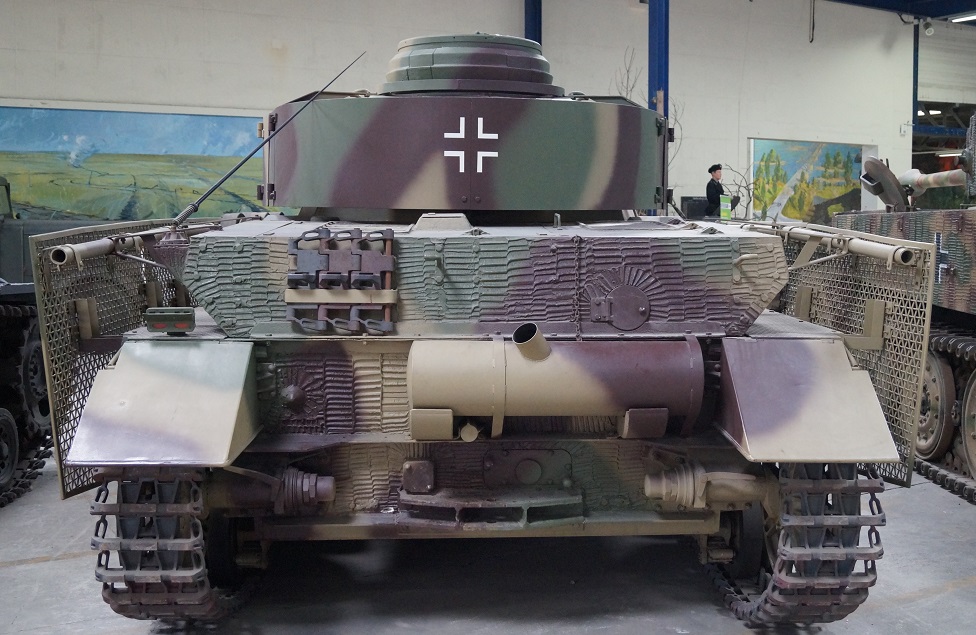
Walkaround vol.26: Sd.Kfz 161 Panzer IV


Subject: Sd.Kfz161 Panzer IV
Location: Musée des Blindés, Saumur, France
Comments:The Panzerkampfwagen IV (PzKpfw IV), commonly known as the Panzer IV, was a German medium tank developed in the late 1930s and used extensively during the Second World War. Its ordnance inventory designation was Sd.Kfz. 161.The Panzer IV was the most widely manufactured German tank of the Second World War, with some 8,500 built. The Panzer IV was used as the base for many other fighting vehicles, including the Sturmgeschütz IV assault gun, Jagdpanzer IV tank destroyer, the Wirbelwind self-propelled anti-aircraft gun, and the Brummbär self-propelled gun. The Panzer IV saw service in all combat theaters involving Germany and was the only German tank to remain in continuous production throughout the war. Upgrades and design modifications, intended to counter new threats, extended its service life. Generally, these involved increasing the Panzer IV's armor protection or upgrading its weapons, although during the last months of the war, with Germany's pressing need for rapid replacement of losses, design changes also included simplifications to speed up the manufacturing process. The Panzer IV was partially succeeded by the Panther medium tank, which was introduced to counter the Soviet T-34, although the Panzer IV continued as a significant component of German armoured formations to the end of the war. The Panzer IV was the most widely exported tank in German service, with around 300 sold to Finland, Romania, Spain and Bulgaria. After the war, Syria procured Panzer IVs from France and Czechoslovakia, which saw combat in the 1967 Six-Day War. 8,553 Panzer IVs of all versions were built during World War II, with only the StuG III assault-gun/tank destroyer's 10,086 vehicle production run exceeding the Panzer IV's total among Axis armored forces