Friday, September 12, 2014

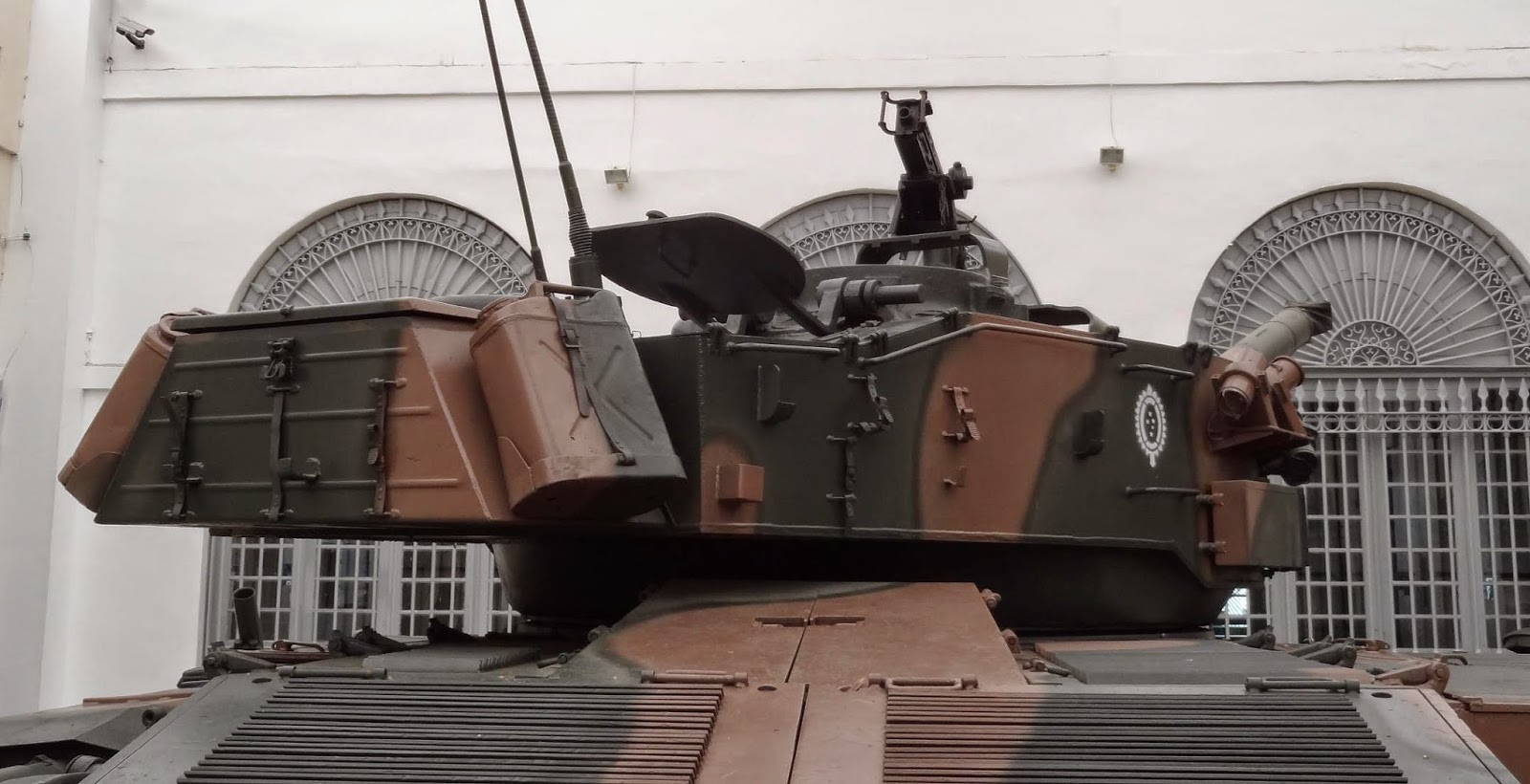
Walkaround vol.16: M41 Walker Bulldog


Subject: M41 Walker Bulldog
Location: South Military Command Museum, Brazil, 2013.
Comments: The M41 Walker Bulldog was a U.S. light tank developed to replace the M24 Chaffee. It was named for General Walton Walker who died in a jeep accident in Korea. On 7 November 1950, the US Ordnance Committee Minutes (OCM) issued item #33476, redesignating the heavy, medium, and light tank, according to the armament; the 120mm (heavy) Gun Tanks, 90mm (medium) Gun Tanks, and the 76mm (light) Gun tanks.
While the M24 Chaffee was a successful design, its main gun was not effective enough against well armored opponents. Although the primary mission of a light tank was scouting, the U.S. Army wanted one with more powerful armament. The development of the new tank, T37, began in 1947. The vehicle was designed to be air-transportable, and the desired anti-tank capabilities were provided by installing a long 76 mm gun with an advanced rangefinder. In 1949, with the adoption of a less ambitious rangefinder, the project's designation was changed to T41. Production started in 1951 at Cadillac's Cleveland Tank Plant, and by 1953 the new tank completely replaced the M24 in the United States Army. Initially it was nicknamed "Little Bulldog", then renamed "Walker Bulldog" after General Walton Walker, who was killed in a jeep accident in Korea in 1950.
The M41 was an agile and well armed vehicle. On the other hand, it was noisy, fuel-hungry and heavy enough to cause problems with air transport. In 1952 work began on lighter designs (T71, T92), but those projects came to naught and were eventually abandoned.
The Brazilian army used 300 of these tanks. A M41C version was introduced in order to extend the service life of these vehicles. In its final version the original gasoline engine was replaced with Brazilian build Saab-Scania DS-14A O4 eight cylinder diesel engine with modifications to the rear hull and electrical system.  The transmission package was upgraded allowing for a top road speed of 70 km/hour. Night vision and a laser range finder were added to the gunsight. Additional spaced armour was included to the forward part of the hull, glacis plate and turret. Four smoke grenade dischargers were added to each side of the turret. Finally the original 76 mm M32 gun was replaced by a 90 mm Ca 76/90 M32 BR3 gun with thermal sleeve and muzzle break made in Brazil. 
(ref: Wikipedia)


Thursday, September 4, 2014

Walkaround vol.2: M151 Mutt

Subject: M151 Mutt
Location: South Military Command Museum, Brazil, 2013.
Comments: The Truck, Utility, l/4-Ton, 4x4, M151 (M151 ) was the successor to the Korean War M38 and M38A1 jeep Light Utility Vehicles. Commonly referred to as a "jeep" or "quarter-ton", it was produced from 1959 through 1982 and served in the Vietnam War. The M151 had a monocoque design making it roomier than previous jeep designs, and incorporated an independent suspension with coil springs. It has since been replaced by the larger AM General HMMWV in most utility roles in frontline use. With some M151A2-units still in U.S. military service in 1999, the M151-series achieved a longer run of service than that of the WW2 MB/GPW, M38 and M38A1 series combined. In 1951 Ford Motor Company was awarded the contract to design a 1/4 ton 4x4 truck to replace the M38 and M38A1 model jeeps. The M151 was developed to specifications and guidance of the U.S. Army's Ordnance Tank Automotive Command. Design started in 1951 and testing and prototyping lasted through most of the fifties. Although the M151 was developed and initially produced by Ford, production contracts for the M151A2 were later also awarded to Kaiser and AM General Corp, a subsidiary of AMC.


Thursday, August 28, 2014

Walkaround vol.15 M3 Scout Car

Subject: M3 Scout Car
Location: South Military Commend Museum, Brazil, 2013
Comments:Design of the vehicle began at the White Motor Company, based in Cleveland, in 1937. It had .25 in (6.4 mm) face-hardened armor, full-time four-wheel drive (with no way to disengage it), four-speed manual constant-mesh (non-synchromesh) transmission (with one reverse gear) and two-speed transfer case, leaf spring suspension, manual steering, and (unusual for the period) vacuum-assisted (power) brakes.The wheelbase was 131 in (3.3 m), tread 65.25 in (1.657 m). The wheels were 8.5 in (220 mm) wide, 20 in (510 mm) diameter, and used standard 12-ply military non-directional tires. Fuel capacity was 30 US gal (110 l). The original order was for 64 units, all of which were given to the 7th Cavalry Brigade. Eventually the Army decided to adopt an improved version, designated M3A1. The new version had a longer and wider hull. In front of the bumper an unditching roller was mounted. The M3A1 could carry up to seven infantry and provide fire support with three machine guns - one .50 caliber (12.7 mm) and two .30 caliber (7.62 mm) - mounted on a skate rail around the hull. Production of the M3A1 started in 1940 and lasted until 1944, with 20,918 vehicles built. The design influenced the later U.S. halftrack designs such as the M3 halftrack and the post-World War II Soviet BTR-40. The early M2 halftrack copied the armor layout as well as the skate rail machine gun mounts.(ref: Wikipedia)


Saturday, August 23, 2014

Military figures vol.8: U-Boot Kapitan in World War II


Subject:
U-Boot Kapitan
Scale:
1/16
Manufacturer:
Verlinden
Price
US$ 20,00 + shipping
Description
Resin casted figure
Comments
This is another great figure representing another combatant of World War II. Verlinden's U-Boot commander has great details and is an easy model to build. It was painted with Tamiya acrylics on the airbrush and Vallejo acrylics with the brush. The base is a resin piece i got here in Brazil.