Friday, May 19, 2017

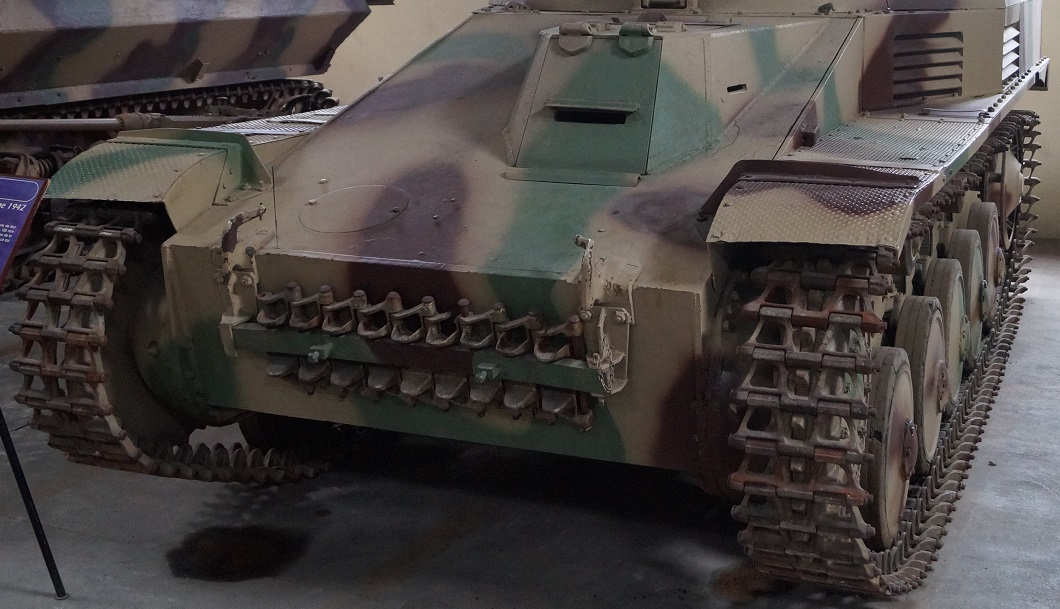
Walkaround vol.24: Sd.Kfz 124 Wespe


Subject:
Location: Musée des Blindés, Saumur, France
Comments:The Sd. Kfz. 124 Wespe (German for "wasp"), also known as Leichte Feldhaubitze 18/2 auf Fahrgestell Panzerkampfwagen II (Sf.) ("Light field howitzer 18 on Panzer II chassis (self-propelled)"), was a German self-propelled artillery vehicle developed and used during the Second World War. It was based on a modified Panzer II chassis.n 1940, during the Battle of France, it was apparent that the intermediate tank of the German forces, the Panzer II, was unsuitable as a main battle tank. Though mechanically sound, it was both under-gunned and under-armoured. The chassis, however, proved servicable for providing mobility to the 10.5 cm field howitzer. Existing chassis were converted to self-propelled artillery vehicles, just as had been done with the Marder II, which was a conversion designed to provide mobility to the PaK 40/7.5 cm anti-tank gun. The design for the Wespe was produced by Alkett, and was based on the Panzer II Ausf. F chassis. Alkett had earlier worked with Alfred Becker to convert captured French armoured vehicles into self-propelled artillery carriers. Amongst other modifications to the Panzer II, the engine was moved forward and the chassis was slightly lengthened to gain sufficient space for the rear-mounted 10.5 cm leFH 18 howitzer. The superstructure was lightly armored, with 10 mm armor plate (enough to stop small arms fire) and was open at the top and to the rear. The vehicles were produced by FAMO's Ursus plant in Warsaw. The Wespe was in production from February 1943 until June 1944, when Soviet forces approached the frontier. By that time, 676 had been produced. An additional 159 were modified to serve as mobile artillery ammunition carriers.




Friday, May 5, 2017

Walkaround vol.23: Sd.Kfz166 Sturmpanzer 43 Brummbär


Subject: Sd.Kfz166 Sturmpanzer 43 Brummbär
Location: Musée des Blindés, Saumur, France
Comments:The Sturmpanzer (also known as Sturmpanzer 43 or Sd.Kfz. 166) was a German armoured infantry support gun based on the Panzer IV chassis used in the Second World War. It was used at the Battles of Kursk, Anzio, Normandy, and was deployed in the Warsaw Uprising. It was known by the nickname Brummbär (German: "Grouch") by Allied intelligence, a name which was not used by the Germans. Just over 300 vehicles were built and they were assigned to four independent battalions. The Sturmpanzer was a development of the Panzer IV tank designed to provide a vehicle offering direct infantry fire support, especially in urban areas. It used a Panzer IV chassis with the upper hull and turret replaced by a new casemate-style armored superstructure housing a new gun, the 15 centimetres (5.9 in) Sturmhaubitze (StuH) 43 L/12 developed by Skoda. It fired the same shells as the 15 cm sIG 33 heavy infantry gun. Thirty-eight rounds, with separate propellant cartridges, could be carried. It used the Sfl.Zf. 1a sight. The combined weight of the shell and cartridge (38 kilograms (84 lb) for an HE shell and 8 kilograms (18 lb) for a propellant cartridge) made the work of the loader arduous, especially if the gun was elevated to a high angle.


Friday, April 21, 2017

Aircraft walkaround vol.79: Bell UH-1A Huey


Subject: Bell UH-1A Huey
Location: Intrepid Air, Sea and Space Museum, New York, USA, 2014.
Comments:The Bell UH-1 Iroquois (nicknamed "Huey") is a military helicopter powered by a single turboshaft engine, with two-blade main and tail rotors. The first member of the prolific Huey family, it was developed by Bell Helicopter to meet a United States Army's 1952 requirement for a medical evacuation and utility helicopter, and first flew in 1956. The UH-1 was the first turbine-powered helicopter to enter production in 1960 for the United States military, and more than 16,000 have been built since. The Iroquois was originally designated HU-1, hence the Huey nickname, which has remained in common use, despite the official redesignation to UH-1 in 1962. The UH-1 first saw service in combat operations during the Vietnam War, with around 7,000 helicopters deployed. The Bell 204 and 205 are Iroquois versions developed for the civil market. The  HU-1A was the Initial Bell 204 production model, redesignated as the UH-1A in 1962 with 182 units built.


Friday, April 14, 2017

Aircraft walkaround vol.80: Sikorsky HH-52 Sea Guard


Subject: Sikorsky HH-52 Sea Guard
Location: Intrepid Air, Sea and Space Museum, New York, USA, 2014
Comments: The Sikorsky HH-52 Seaguard (company designation S-62) was a single turbine engine, three-blade rotor amphibious helicopter. Originally developed as a commercial venture by the Sikorsky Aircraft Corporation of Stratford, Connecticut, it was used by the United States Coast Guard primarily for air-sea rescue. The HH-52 has been replaced by non-amphibious types such as the HH-65 Dolphin, which rely solely on the use of a winch from a low hover to conduct rescue operations.A number of S-62s were bought by the US Navy Bureau of Aeronautics for the US Coast Guard for use as a search and rescue helicopter. Initially designated HU2S-1G Seaguard, it was re-designated as the HH-52A Seaguard in 1962.The HH-52A used a boat hulled shaped fuselage, smaller but similar to the US Navy's SH-3 (Sikorsky S-61), and was employed aboard the larger Coast Guard cutters and icebreakers. The S-62 used a single 1,250 hp (930 kW) General Electric T58-GE-8B turboshaft engine, a derated version of the T58-GE-10 powerplant used on the larger twin-engined SH-3; and a 1,050 hp T58-GE-6 derated to 670 hp, moving the same main and tail rotor as S-55 Model, in the prototype.The turbine powered S-62 could carry more weight and fly faster than the H-19 (S-55). The aircraft was first conceived and designed to be amphibious so that flotation gear would not be required for over water flights, and rescues could be made by landing on the water. The fuselage is watertight for landings on water or snow. Two outrigger floats resist pitching and rolling on the water. Although the HH-52A looks very different from the Sikorsky H-19, it used many of the same components.


Thursday, April 6, 2017

Aircraft walkaround vol.78: Bell AH-1J Sea Cobra


Subject: Bell AH-1J Sea Cobra
Location: Intrepid Air, Sea, Space Museum, New York, USA, 2014
Comments:The AH-1 Cobra was developed in the mid-1960s as an interim gunship for the U.S. Army for use during the Vietnam War. The Cobra shared the proven transmission, rotor system, and the T53 turboshaft engine of the UH-1 "Huey". By June 1967, the first AH-1G HueyCobras had been delivered. Bell built 1,116 AH-1Gs for the U.S. Army between 1967 and 1973, and the Cobras chalked up over a million operational hours in Vietnam.The U.S. Marine Corps was very interested in the AH-1G Cobra, but it preferred a twin-engine version for improved safety in over-water operations, and also wanted a more potent turret-mounted weapon. At first, the Department of Defense had balked at providing the Marines with a twin-engine version of the Cobra, in the belief that commonality with Army AH-1Gs outweighed the advantages of a different engine fit. However, the Marines won out and awarded Bell a contract for 49 twin-engine AH-1J SeaCobras in May 1968. As an interim measure, the U.S. Army passed on 38 AH-1Gs to the Marines in 1969. The AH-1J also received a more powerful gun turret. It featured a three barrel 20 mm XM197 cannon that was based on the six barrel M61 Vulcan cannon.