Friday, June 13, 2014

Spacecraft vol. 4: Little Joe Apollo Test Rocket


Subject:
Little Joe II - Apollo Program LES Test Launch Vehicle
Scale:
1/144
Manufacturer:
New Ware models
Price
US$ 35,00 + shiping
Description
Resin casting with photo-etched metal parts and decals
Comments
This is another great kit from New Ware models. The Litlle Joe II was a solid fuel rocket design used to test the escape system for the Apollo Moon Vehicle. As you can see from the video below, it proved that this system work perfectly! New Ware´s kit is nicely produced with yellow resin for all the major parts, with photo-etched metal parts for some airframe details and the escape tower. Fit is very nice and construction is simple. There is a fantastic decal sheet with all the tracking markings. The base was scratch built.

The kit´s box and parts:


A few construction pictures:


The finished model:


A video showing a Little Joe II launch:


Wednesday, June 11, 2014

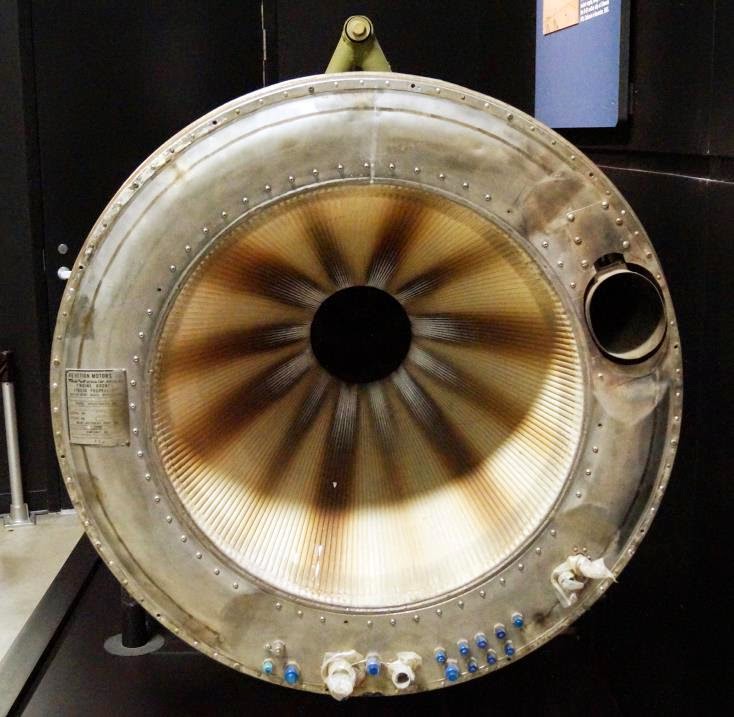
Engine walkaround vol.15 : Reaction Motors XLR-99

Subject: Reaction Motors XLR-99
Location: USAF Museum, Dayton, Ohio, USA, 2014
Comments: The XLR99 engine was the first large, throttleable, restartable liquid propellant rocket engine. Development began in the 1950s by the Reaction Motors Division of Thiokol Chemical Company to power the X-15 research aircraft. It could deliver up to 57,000 pounds force (254 kN) of thrust with an Isp of 279 seconds (239 seconds sl). Thrust was variable from 50 to 100 percent, and the restart capability allowed it to be shut down and restarted during flight when necessary.(References: Wikipedia)


Saturday, June 7, 2014

Weapons Walkaround vol.4: LGM118 Peacekeeper ICBM

Subject: LGM118 Peacekeeper ICBM
Location: USAF Museum, Dayton, Ohio, USA
Comments: The LGM-118A Peacekeeper, also known as the MX missile (for Missile-eXperimental), was a land-based ICBM deployed by the United States starting in 1986. The Peacekeeper was a MIRV missile; it could carry up to 10 re-entry vehicles, each armed with a 300-kiloton W87 warhead/Mk21 RVs. A total of 50 missiles were deployed starting in 1986, after a long and contentious development program that traced its roots into the 1960s. Under the START II treaty, which never entered into force, the missiles were to be removed from the U.S. nuclear arsenal in 2005, leaving the LGM-30 Minuteman as the only type of land-based ICBM in the U.S. arsenal. Despite the demise of the START II treaty, the last of the LGM-118A "Peacekeeper" ICBMs (but not their warheads) were decommissioned on September 19, 2005. Current plans are to switch 500 decommissioned Peacekeepers' W87/Mk21 warheads to the Minuteman III. Among the reasons cited for decommissioning of the Peacekeeper ICBM was its failure to achieve the program's range objectives. The private launch firm Orbital Sciences Corporation has developed the Minotaur IV, a four-stage civilian expendable launch system, from the Peacekeeper, using old Peacekeeper components(References: Wikipedia)


Wednesday, June 4, 2014

Military Uniforms Walkaround vol.2: Col. Robin Olds Combat Gear

Subject: Combat gear used by Col. Robin Olds in Vietnam
Location: USAF Museum, Dayton, Ohio, USA, 2014
Comments: Robin Olds (July 14, 1922 – June 14, 2007) was an American fighter pilot and general officer in the U.S. Air Force. He was a "triple ace", with a combined total of 16 victories in World War II and the Vietnam War. He retired in 1973 as a brigadier generalThe son of regular Army Maj. Gen. Robert Olds, educated at West Point, and the product of an upbringing in the early years of the U.S. Army Air Corps, Olds epitomized the youthful World War II fighter pilot. He remained in the service as it became the United States Air Force, despite often being at odds with its leadership, and was one of its pioneer jet pilots. Rising to the command of two fighter wings, Olds is regarded among aviation historians, and his peers, as the best wing commander of the Vietnam War, for both his air-fighting skills, and his reputation as a combat leader. Olds was promoted to brigadier general after returning from Vietnam but did not hold another major command. The remainder of his career was spent in non-operational positions, as Commandant of Cadets at the United States Air Force Academy and as an official in the Air Force Inspector General's Office. His inability to rise higher as a general officer is attributed to both his maverick views and his penchant for drinking. Olds had a highly publicized career and life, including marriage to Hollywood actress Ella Raines. As a young man he was also recognized for his athletic prowess in both high school and college, being named an All American for his play as a lineman in American football. Olds expressed his philosophy regarding fighter pilots in the quote: "There are pilots and there are pilots; with the good ones, it is inborn. You can't teach it. If you are a fighter pilot, you have to be willing to take risks. (reference: Wikipedia)


Friday, May 30, 2014

Aircraft Walkaround vol. 40: McDonnell-Douglas F-4C Phamtom II Col. Robin Olds


Subject: McDonnell-Douglas F-4C Phamtom II - Col. Robin Olds Scat XXVII (F-4C-24-MC 64-0829) 
Location: USAF Museum, Dayton, Ohio, USA, 2014.
Comments: First flown in May 1958, the Phantom II originally was developed for U.S. Navy fleet defense. The U.S. Air Force's first version, the F-4C, made its first flight in May 1963, and production deliveries began six months later. Phantom II production ended in 1979 after over 5,000 had been built -- more than 2,600 for the USAF, about 1,200 for the U.S. Navy and Marine Corps, and the rest for friendly foreign nations. 

In 1965 the USAF sent its first F-4Cs to Southeast Asia, where they flew air-to-air missions against North Vietnamese fighters as well as attacking ground targets. The first USAF pilot to score four combat victories with F-4s in Southeast Asia was Col. Robin Olds, a World War II ace. The aircraft on these pictures is the one in which Col. Olds, the pilot, and Lt. Stephen Croker, the weapons system officer, destroyed two MiG-17s in a single day, May 20, 1967. 
In its air-to-ground role, the F-4C could carry twice the normal load of a WWII B-17. The armament loaded on the aircraft on display is a typical configuration for an F-4C in 1967. It consists of four AIM-7E and four AIM-9B air-to-air missiles, and eight 750-pound Mk 117 bombs. The aircraft also carries two external fuel tanks on the outboard pylons and one ALQ-87 electronic countermeasures (ECM) pod on the right inboard pylon. (References: USAF Museum)


Saturday, May 24, 2014

Weapons walkaround vol.3 : Fritz X

Subject: Fritz X
Location: RAF Museum, Hendon, London UK, 2013
Comments: The Fritz X was a further development of the high-explosive bomb SD 1400 (Splitterbombe, dickwandig, 1400 kg. It was a penetration weapon intended to be used against heavily protected targets such as heavy cruisers and battleships. It was given a more aerodynamic nose, four stub wings, and a box shaped tail unit, consisting of a roughly 12-sided annular set of fixed surfaces, and a cruciform tail with thick surfaces within the annulus, which themselves contained the aerodynamic controls. The Luftwaffe recognized the difficulty of hitting moving ships during the Spanish Civil War. Dipl. engineer Max Kramer, who worked at the DVL, had been experimenting since 1938 with remote-controlled free-falling 250 kg bombs, and in 1939 fitted radio-controlled spoilers. In 1940, Ruhrstahl was invited to join the development since they already had experience in the development and production of unguided bombs.
On 9 September, the Luftwaffe achieved their greatest success with the weapon. After Pietro Badoglio publicly announced the Italian armistice with the Allies on September 8, 1943, the Italian fleet had steamed out from La Spezia and headed to Malta. To prevent the ships from falling into Allied hands, six Do 217K-2s from III. Gruppe of KG 100 (III/KG 100) took off, each carrying a single Fritz X. The Italian battleship Roma, flagship of the Italian fleet, received two hits and one near miss, and sank after her magazines exploded. 1,255 men, including Admiral Carlo Bergamini, died. Her sister ship, Italia, was also damaged but reached Malta.The American light cruiser Savannah was hit by Fritz-Xs at 10:00 on 11 September 1943 during the invasion of Salerno, and was forced to retire to the United States for repairs. The light cruiser HMS Uganda was hit by a Fritz-X off Salerno at 1440 on 13 September. KG 100 scored another success with Fritz-X while the British battleship Warspite was providing gunfire support at Salerno on 16 September. She took on a total of 5,000 tonnes of water and lost steam (and thus all power, both to the ship herself and to all her systems), but casualties were few.
By the time of Normandy landings, a combination of Allied air supremacy, keeping bombers at bay, and ship-mounted jammers meant the Fritz-X had no significant effect on the invasion fleet. Some accounts say the Norwegian destroyer Svenner was hit by Fritz-X at dawn on D-Day. This is highly unlikely as III./KG 100, the unit which carried the Fritz-X into combat, had largely been re-equipped with the Hs 293 missile by that time for its anti-ship missions, and the attack on Svenner occurred before the first glide bombers launched their assaults on the Normandy beaches.