Sunday, April 21, 2013

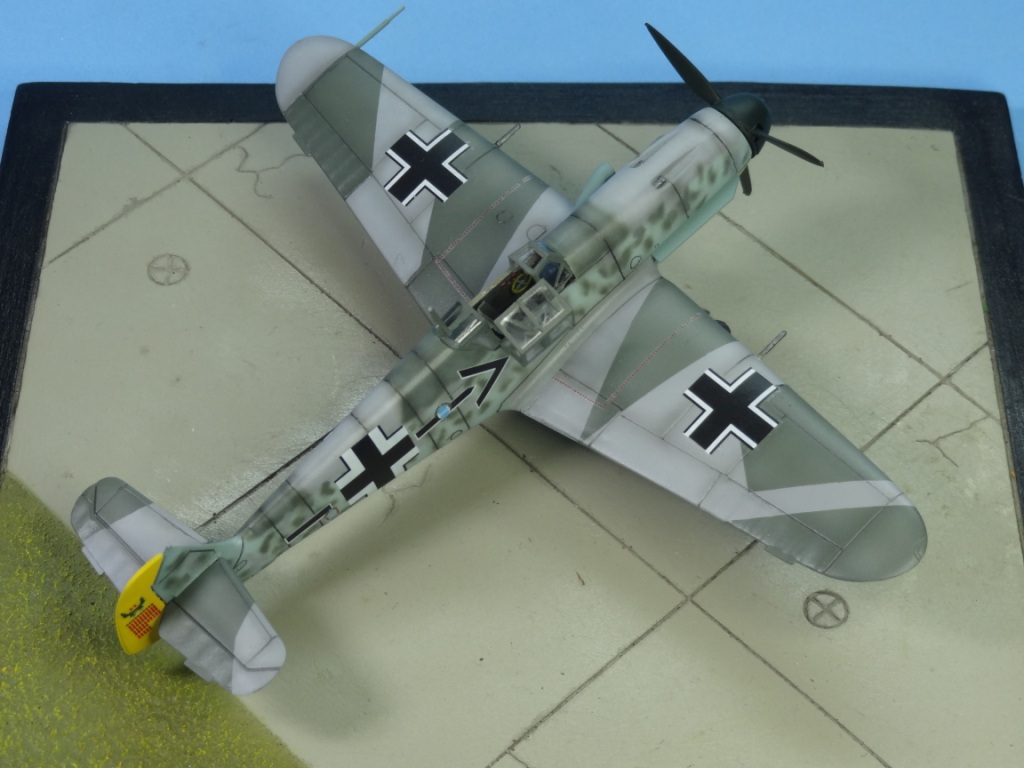
Military aircraft vol.54

Subject: Messerschmitt BF109F-2
Scale: 1/72
Manufacturer: Italeri
Construction: Out of the box, painted with Tamiya acrilics and decorated with Italeri´s decals.
Comments: I know that Italeri´s BF109F is far from being the best Friedrich to build. However, it is not hard to find and has a low price tag anywhere in the world. I could not resist building one with Adolf Galland´s markings, despite the fact that the General considered this a step back in evolution when  compared to the Emils. 


Military Aircraft vol.53


Subject: Messerschmitt BF109G6
Scale: 1/72
Manufacturer: Academy
Construction: Out of the box, painted with Tamiya acrilics, decorated with Academy´s decals.
Comments: I enjoy building Academy kits. They have nice fit and detail. This BF109G6 is just like that: overall well detailed, with good fit, almost a weekend project. For me Academy´s models have only one problem: the decals. Silvering is very common and they don´t react to any decal solvent. Other then that, this Messerschmitt was a pleasure to build.


Saturday, April 20, 2013

Aircraft walkaround vol.16: Sikorsky H-19 Chickasaw ( Model S-55)

Subject: Sikorsky H-19 Chickasaw ( Model S-55)
Location Deutches Museum, Munich, Germany 2012.
Comments: The Sikorsky H-19 Chickasaw, (also known by its Sikorsky model number, S-55) was a multi-purpose helicopter used by the United States Army and United States Air Force. It was also license-built by Westland Aircraft as the Westland Whirlwind in the United Kingdom. United States Navy and United States Coast Guard models were designated HO4S, while those of the U.S. Marine Corps were designated HRS. In 1962, the U.S. Navy, U.S. Coast Guard and U.S. Marine Corps versions were all redesignated as H-19s like their U.S. Army and U.S. Air Force counterparts.The H-19's first flight was on November 10, 1949 and it entered operations in 1950. Over 1,000 of the helicopters were manufactured by Sikorsky for the United States. The H-19 Chickasaw holds the distinction of being the US Army's first true transport helicopter and, as such, played an important role in the initial formulation of Army doctrine regarding air mobility and the battlefield employment of troop-carrying helicopters. The H-19 underwent live service tests in the hands of the 6th Transportation Company, during the Korean War beginning in 1951 as an unarmed transport helicopter. Undergoing tests such as medical evacuation, tactical control and front-line cargo support, the helicopter succeeded admirably in surpassing the capabilities of the H-5 Dragonfly which had been used throughout the war by the Army. The U.S. Air Force ordered 50 H-19A’s for rescue duties in 1951. These aircraft were the primary rescue and medical evacuation helicopters for the USAF during the Korean War. The Air Force continued to use the H-19 through the 1960s, ultimately acquiring 270 of the H-19B model.


Tuesday, April 16, 2013

Work in progress vol.3: German anti-tank and flak bunker

Subject: German Anti-tank and Flak bunker
Scale: 1/72
Manufacturer: Italeri
Step 1: In this project i will add to the bunker a 20mm Flakvierling 38 anti-aircraft  gun from italeri kit number 7026. This set also has the 75mm PAK anti-tank gun. This is a nice model that, once built, will be placed inside the bunker with little to be seen. So i decided to use the much more simple and inexpensive PAK 40 that comes in italeri kit number 6096. Some research will be needed as these bunkers were often camouflaged and had a series of lines of defense around them. The diorama will be placed over a 20X25cm picture frame. Bellow are the pictures of the armament kits that will be used:


Step 2: Research can be very usefull for the quality of your model and diorama. There are lots of references for the german bunkers in World War II. I found lots of informations in George Foty´s Fortress Europe - Hitler´s atlantic wall, published by Ian Allan Publishing in 2002. The closest diagram of Italeri´s bunker is the type 677 german design. The 600 series of bunkers were created for the atlantic wall and were considered bombproof, with walls of 2m to 3.5m thick. The 677 model was to be used in flanking fire, so it was constructed with a lateral wing and wall that faced the enemy line of attack. Usually, it housed a 88mm or larger gun. In line with this, a had to replace the PAK40 with an 88mm anti-tank gun. The only one i could get was the 1/76 scale airfix kit. Since it will be placed inside the bunker, the small diference in scale won´t be a problem. Bellow you see a diagram of the 677 bunker. The photo shows a type677 bunker with AA guns on top of it. This bunker however was under new administration, as canadian troops were handling the guns!


Step 3: The photo of the model of the bunker shown up here illustrates how the model was built. Instead of using the old airfix 88mm AT gun, i got now the italeri kit number 7512 of the same gun but in 1/72 scale and with some figures in nice poses also in 1/72. Pictures of this kit are below now:


Saturday, April 13, 2013

Engine walkaround vol.13: Packard V1650 Merlin

Subject: Packard V1650 Merlin
Location: Fantasy of flight museum, Florida, USA, 2013
Comments: The Packard V-1650 was a version of the Rolls-Royce Merlin aircraft engine, produced under licence in the United States by the Packard Motor Car Company. The engine was licensed in order to provide a 1,500 hp (1,100 kW; 1,500 PS)-class design at a time when U.S. engines of this rating were not considered ready for use even after years of development.
The first V-1650s, with a simple one-stage supercharger, were used in the P-40F Kittyhawk fighter. Later versions included a much more advanced two-stage supercharger for greatly improved performance at high altitudes. It found its most famous application in the North American P-51 Mustang fighter, where it vastly improved that aircraft's performance at altitude, transforming the Mustang into an outstanding fighter with the range and performance to escort heavy bombers over the European continent. By 1944, P-51B, P-51C and P-51D "Merlin" Mustangs were able to escort Allied heavy bombers in daylight all the way to Berlin and yet were still capable of combating German fighters attempting to intercept the bombers. By late 1944, the Allies had won air supremacy over the whole of Germany, and Germany's defeat in World War II began to appear inevitable.


Subject: Rolls-Royce PV12 Merlin
Location: Deutches Museum, Munich, Germany, 2012
Comments: The Rolls-Royce Merlin is a British liquid-cooled, V-12, piston aero engine, of 27-litre (1,650 cu in) capacity. Rolls-Royce Limited designed and built the engine which was initially known as the PV-12: the PV-12 became known as the Merlin following the company convention of naming its piston aero engines after birds of prey.
The PV-12 first ran in 1933 and, after several modifications, the first production variants were built in 1936. The first operational aircraft to enter service using the Merlin were the Fairey Battle, Hawker Hurricane and Supermarine Spitfire. More Merlins were made for the four-engined Avro Lancaster heavy bomber than for any other aircraft; however, the engine is most closely associated with the Spitfire, starting with the Spitfire's maiden flight in 1936. A series of rapidly applied developments, brought about by wartime needs, markedly improved the engine's performance and durability.
Considered a British icon, the Merlin was one of the most successful aircraft engines of the World War II era, and many variants were built by Rolls-Royce in Derby, Crewe and Glasgow, as well as by Ford of Britain at their Trafford Park factory, near Manchester. The Packard V-1650 was a version of the Merlin built in the United States. Production ceased in 1950 after a total of almost 150,000 engines had been delivered, the later variants being used for airliners and military transport aircraft.